RENR 690 Jacob Beauregard
Field + Laboratory Methodology & Analytical Framework
My project and the data generated herein had a hierarchical and nested structure, with multiple plots established in each of our four sites that reflected the intended gradients of dominant mycorrhizal types. Inside each plot established, multiple seedlings were measured and harvested. Soils were collected adjacent to seedlings, and environmental characteristics, forest stand composition, and vegetation communities were assessed. Whole seedlings and soils were transported back to the laboratory for further assessments of soil physicochemical variables, as well as for DNA extractions and sequencing of the root and soil fungal communities of all 435 seedlings.
Field sites

Figure 8. Field sampling sites throughout the south of Quebec, Canada. Sites are displayed in black, with their respective bioclimnatic domains represented according to colour (source: Melanie Desrochers, Centre d'étude de la fôret (CEF)).
Field-based methods
During the late spring and summer of 2024 (June and July 2024), sugar maple (average height of ± 17 cm; average age of ± 8 years old) and hemlock seedlings (average height of ± 20 cm) were found at our four sites (Figure 8) and selected within our designated plots according to the following criteria; unhealthy appearing seedlings were avoided so as not to overrepresent pathogenic fungal taxa. Harvested seedlings could not be beside another seedling meant for sampling. The age of seedlings (in years) was estimated by assessing bud scars on shoots. Annual growth was assessed by taking the average of the last three years growth (in mm) by measuring between bud scar nodes. Hemlock seedlings lacked these features and thus could not be measured for age or annual growth. Basal diameter of seedlings (mm) was measured with electronic calipers. Crown width was taken by averaging the measurements of length and width of the crown (cm). Slope (degrees), elevation (m), substrate, and canopy cover (%) were recorded for each seedling. Vegetation surveys were done within a 1 m radius of each seedling.
Seedlings were carefully extracted and placed in sterile bags for later DNA extractions and sequencing of roots. Soil samples were collected with a trowel, with the leaf litter layer removed before sampling the topsoil, sterilizing the trowel between samples. Samples were extracted by digging holes of a 10 cm radius and down to the approximate rooting depth of seedlings. Soil samples were taken from each cardinal direction within a 1 m radius of each seedling and homogenized in a sterile bag before further processing. Soils and seedlings were transported on ice in coolers back to the laboratory where they were subsequently stored at -20C before further processing. In total, 435 seedlings (263 sugar maple; 172 hemlock) were harvested and georeferenced across all four sites. At Mégantic, we collected 110 seedlings (81 maple; 29 hemlock) and 110 corresponding soil samples. At Sutton, we collected 141 seedlings (87 maple; 54 hemlock) and 141 corresponding soil samples. At the Station de biologie des Laurentides (hereby referred to as SBL), we collected 103 seedlings (50 maple; 53 hemlock) and 103 corresponding soil samples. At Lac-des-Plages (hereby referred to as LDP), we collected 77 seedlings (40 maple; 37 hemlock) and 77 corresponding soil samples.

Figure 9. Schematic depiction of field sampling protocol, describing how basal areas for plots, growth and environmental metrics, as well as data for later labboratory analyses were coolected (created in Biorender).
At each site (Figure 8), plots were chosen and basal areas were measured within a 20 m x 20 m area (Figure 9). Plots were selected according to visual assessments of canopy forming tree composition. Plots were selected if they were more than 10 m away from any path and approximately 50 m away from other plots. Plots were assigned a mycorrhizal type (AM, EM, mixed) based on the following characteristics: stands were AM dominated if ≥ 80% of their relative basal area was represented by AM trees; stands were EM dominated if ≥ 80% their relative basal area was represented by EM trees; stands were mixed if the relative basal area of AM and EM stems were approximately equal, with basal area proportions of AM and EM trees ranging from no more than 60-40% (or vice versa). Basal area was calculated by converting DBH measurements of individual stems (cm) to m2 and summing the estimated areas, yielding estimates for total basal area and basal area by mycorrhizal type. Stems below 10 cm in DBH were excluded. In total, 35 plots were established across all sites. At Mégantic, 12 plots were established (5 EM, 4 mixed, 3 AM). At Sutton, 12 plots were established (4 EM, 4 mixed, 4 AM). At SBL, only 6 plots were established (2 EM, 2 mixed, 2 AM) and at LDP 5 plots were established (2 EM, 2 mixed, 1 AM). I had initially planned to have three plots of each mycorrhizal type (EM, AM, mixed) at each site, yielding 9 plots per site with a total of 36 plots. While I did my best to adhere to this plan, technical constraints and lack of sufficient human resources limited sampling in some of our sites (e.g., LDP and SBL).
Laboratory methods

Figure 10. Schematic depiction of laboratory protocol for root and soil processing including DNA extractions, sequencing, and physicochemical analyses (created in Biorender).

Roots
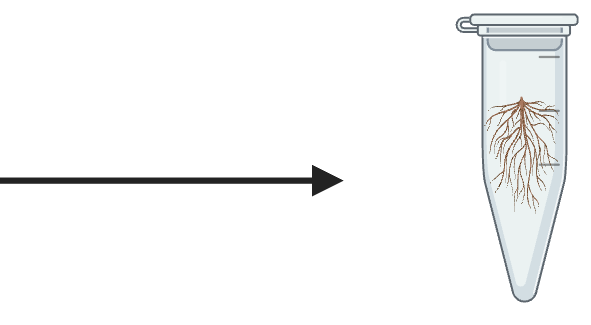
In the lab (Figure 10), the rooting systems of our seedlings were sampled in a representative fashion by making sure to sample from each portion of the rooting system. DNA extractions and sequencing of the fungal communities of roots were then undertaken using the DNEasy Powersoil Pro kit (QIAGEN, Hilden, Germany), with only acquisitive roots being used for DNA sequencing. For soils, composite samples were run through a 2 mm sieve to remove coarse debris and homogenize samples. 250 mg of soil was transferred into tubes for DNA extractions using the same extraction kit as the roots. A subset of soils (100 samples) were used for physicochemical analyses. From these, a large sub-sample (~100 ml) was retained, as well as a small sub-sample (~10 ml) which was finely ground. Subsequently, the two sub-samples were sent to the Ministère des Forêts, de la Faune et des Parcs (Government of Quebec) for further physicochemical analyses. Soil and fungal communities were all sequenced via metabarcoding at the UdeS microbiology station and by targeting the internal transcribed spacer (ITS) region, the universal barcode for fungi.
Bioinformatics
Sequencing reads for fungi went through quality control and chimera filtering, amplicon sequence variant (ASV) clustering and taxonomic assignment in R version 4.5.0 (R Core Team 2025) with the DADA2 pipeline (version 1.36.0) (Callahan et al. 2016) and the UNITE reference database (version 19.02.2025) for fungi (Abarenkov et al. 2025). FUNGuild (FUNGuildR v0.3.0) was used for the analysis of fungal functional groups (Nguyen et al. 2016). For fungi, maximum expected errors for both forward and reverse reads were set to two and we enforced a minimum length of 150bp to get rid of falsely attributed low-length sequences. I filtered all samples to remove any sequence present less than 50 times across all samples and any sample containing fewer than 5000 reads to control for potential artifacts created in processing. For our fungal data we started with 19,152 ASVs and ended up with 4155 after quality filtering. All samples were treated with various functions from Phyloseq 1.52.0 (McMurdie and Holmes 2013) to produce a phyloseq object that was then used for all subsequent analyses.