RENR 690 Jacob Beauregard
Data preparation and visualization
Data for growth metrics and environmental variables were collected in the field. Soil chemical and nutrient characteristics, as well as DNA sequences and taxonomic/functional assignments were attained and assessed via laboratory protocols and bioinformatic pipelines.
To assess whether broad patterns in fungal community composition might instead reflect experimental design effects, I explored the data at the sample level before conducting formal analyses. This included ordinations based solely on fungal community composition, visualized for individual samples and coloured by site, plot type, and compartment, as well as boxplots of fungal guild abundances and soil variables across sites and forest types. Together, these exploratory figures were used to assess dispersion, potential outliers, and whether variation appeared to be dominated by site identity or by the ecological gradients of interest.

Figure 11. Fisheye lens assessment of canopy cover (source: Jacob Beauregard)
Seedling Metadata
Sample of metadata structure for seedlings and their associated site, growth, environmental metrics, and fungal communities

Figure 12. Seedling growth, environmental characteristics, soil and functional group abundance master dataset derived from field measurements and laboratory processing.
This dataset contains seedling-level observations of sugar maple (Acer saccharum) and eastern hemlock (Tsuga canadensis) collected across four sites in souther Quebec spanning a gradient of dominant mycorrhizal types (AM, EM, and mixed). For each seedling, we integrated growth measurements, fungal guild abundances derived from DNA metabarcoding, and associated environmental variables (Figure 12). This unified dataset forms the basis for all subsequent analyses.
Fungal guild composition across plot types and compartments

Figure 13. Distribution of fungal guild abundances across plot types (AM, EM, and mixed) and sample compartments (root and soil). Boxplots show the spread of values across individual samples, with points representing individual observations. This visualization was used to assess variation, identify potential outliers, and evaluate patterns in guild composition across plot types and compartments prior to formal statistical analyses.
Fungal communities were composed of multiple functional guilds, including ectomycorrhizal, arbuscular mycorrhizal, saprotrophic, pathogenic, and endophytic taxa. Relative abundances varied across plot types and between root and soil compartments (Figure 13), highlighting differences in community composition across ecological contexts.

Fungal community ordinations per sample, site, and in relation to growth

Ordination analyses based on Bray–Curtis dissimilarities were used to visualize patterns in fungal community composition across samples (Figure 15; left panel). These ordinations revealed underlying structure associated with plot type and compartment, while also allowing us to assess potential clustering by site (Figure 14) and identify any site-level effects or outliers prior to formal statistical testing.
To explore whether variation in community composition corresponded with seedling performance, ordination points were scaled by annual growth (Figure 15; right panel). This visualization provides a qualitative assessment of whether growth patterns align with major axes of fungal community variation.
Figure 14. Sample-level PCoA ordination of fungal community composition colored by site. Points represent individual samples across all plot types, hosts, and compartments. This visualization was used to assess potential site-level clustering, batch effects, or geographic structuring of fungal communities prior to statistical analyses.
Figure 15. Sample-level PCoA ordination of fungal community composition (Bray–Curtis) at the genus level. Points represent individual samples, coloured by plot type (AM, EM, mixed) and shaped by compartment (root vs soil). In the second (right) panel, point size is scaled by annual seedling growth to visualize potential associations between fungal community structure and host performance. These ordinations were used to assess overall community patterns, dispersion, and potential relationships between composition and growth prior to formal statistical testing.

Ordination analyses based on Bray–Curtis dissimilarities were used to visualize patterns in fungal community composition across samples (Figure 15; left panel). These ordinations revealed the underlying structure associated with plot type, compartment, and site, providing a multivariate representation of community differences prior to formal statistical testing.
To explore whether variation in community composition corresponded with seedling performance, ordination points were scaled by annual growth (Figure 15; right panel). This visualization provides a qualitative assessment of whether growth patterns align with major axes of fungal community variation.
Soil variables across sites

Figure 16. Distribution of soil chemical variables (Ca, Mg, mineral N, NH₄⁺, NO₃⁻, and pH) across sampling sites. Boxplots summarize variation within sites and highlight differences in central tendency and spread among locations. This figure was used to evaluate environmental heterogeneity across sites that may contribute to variation in fungal community composition.
Soil physicochemical properties varied across sites (Figure 16), reflecting differences in underlying environmental conditions. Variables including calcium, magnesium, mineral nitrogen, and pH exhibited site-level variation, providing important abiotic context for interpreting patterns in fungal community composition and seedling performance.
Exploratory plots for ordinations and growth with functional guild abundances
Exploratory visualizations were used to assess potential relationships between components of the broader fungal community and seedling growth(Figure 17). These plots were made to provide some intuition regarding the possible patterns in our data and to guide formal modelling approaches, rather than to support inferences and broader conclusions.
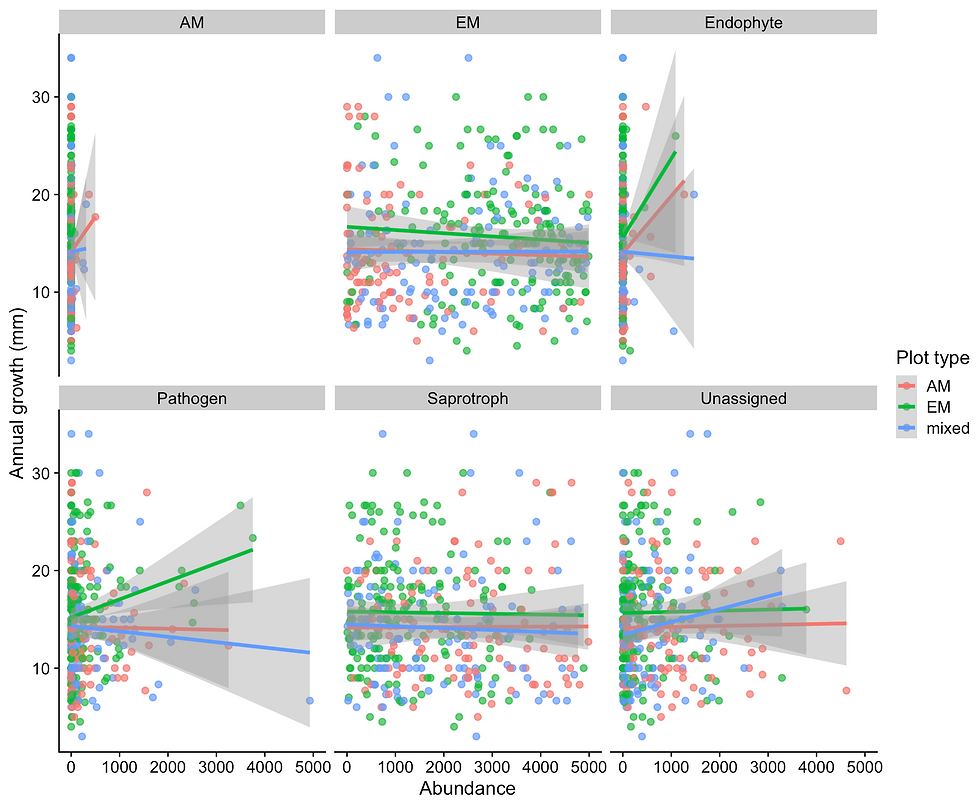
Figure 17. Relationships between fungal guild abundance and annual seedling growth across plot types. Points represent individual samples, colored by plot type, with linear fits and confidence intervals shown for each group. Panels correspond to fungal guilds (AM, EM, endophytes, pathogens, saprotrophs, and unassigned taxa). These plots were used to explore potential associations and variability prior to formal modeling.
Assessment of structure of fungal communities, along with all tested guilds and soil variables overlaid as envfit arrows were visualized according to forest plot type and regardless of significance (Figure 18). Further estimates of fungal pathogen abundances across plots were assessed.

Figure 18. Centroid-based PCoA ordination of fungal community composition (Bray–Curtis) summarized by host species, plot type (AM, EM, mixed), and compartment (root, soil). Points represent group centroids, and arrows indicate environmental and functional variables significantly associated with community composition (envfit, p ≤ 0.05). Vector direction reflects the gradient of increasing values, and vector length indicates the strength of correlation with ordination axes. This analysis provides an overview of major gradients structuring fungal communities across hosts, plot types, and compartments.